| |
Sustainable
Global Stewardship Program
Condensed Spring Semester:
27 February - 27 April, 2028
This program is offered in conjunction with:
Universidad de San José (Costa Rica)
**Open to students from all campuses worldwide** |
| |
|
|
| |

|
|
| |
Past group at a local conservation
project as we prepare for a
tree-planting activity. |
|
|
 Prerequisites Prerequisites
The Spring semester program has the following prerequisites:
. A minimum cumulative grade point average (GPA) of 2.5 on a 4 point scale.
. Successful completion of 15 semester credits at an accredited college or university, or prior approval.
. Personal qualities that will facilitate a safe and supportive experience for all, as well as a sincere interest in learning and contributing positively to the program (see 'General Requirements').
. Recommended (not required): Prior Spanish language study and/or other appropriate experience, and successful completion of an introductory environmental studies, global systems, community development, or related course.
Field Study & Volunteer Work
The principal location of the program will be San Ramón, Costa Rica, where participants will live with Costa Rican families. In addition to time spent in the classroom in San Ramón, the program includes substantial field study in the region, during which lodging is provided by field stations, hotels, community projects, or other appropriate facilities. Typical educational travel includes the following:
• Day-long and multiple-day field trips to appropriate sites in Costa Rica (e.g., sustainable businesses, organic farms, watershed conservation sites, renewable energy projects, private reserves, national parks, volcanoes, community ecotourism projects). See Field Study Locations for more information.
• An extended field excursion (typically four days) in Southwestern Nicaragua (e.g., Rivas, Managua, Masaya, Granada); including extensive field study, cultural events, and volunteer work.
• Volunteer service-learning work at selected field study sites. Possible sites include, but are not limited to, the following: Organic agriculture, sustainable businesses, environmental education, social work, environmental conservation, ecotourism, and housing construction for low-income families.
NOTE: See selected postings, photos & video from previous years in the MediaBlog.
For additional information on these locations, see the links page.
Course Work
This program provides an in-depth, hands-on learning experience in Costa Rica, as well as a field excursion to Nicaragua. Because no Spanish is required, and the curriculum is extremely interdisciplinary in nature, the program is suitable for all majors. Twelve to fifteen units of academic credits will be provided by the University of San José (USJ) in Costa Rica, which also provides facilities and logistical support.
For more information, see the Academic Credit section of the 'Offerings' page. Courses are listed below. All participants will typically enroll in the first three courses, and select from the appropriate Spanish course.
If at the advanced Spanish level, participants may arrange other independent work in place of selecting a Spanish course.
All courses are taught in English with the exception of the Spanish courses, which will include practical application of the language.
Sustainability in Central America (3 cr.)
An interdisciplinary synthesis of the principal concepts associated with sustainability in Central America. Emphasis on key global socio-economic issues in perspective and environmental sustainability in tropical ecosystems: Natural history, environmental conservation, ecotourism, agriculture & land use, marine ecology, and/or urban ecology. The course will include lectures, guest speaker presentations, discussion, and various other class activities. Co-requisite of 'Applied Sustainability in Central America'. For more information, see online course materials, or see a tentative syllabus here (Adobe pdf document).
USJ Credit: BCB 120; Educación para Desarrollo Sostenible.
| |
 |
|
| |
A few possible volunteer work sites: Organic farming, construction,
and composting.
|
|
| |
|
|
Applied Sustainability in Central America (3 cr.)
An interdisciplinary field-based synthesis of sustainability in Central America, with emphasis on personal sustainable living strategies and local community sustainability efforts related to environmental conservation, community development, social equity, sustainable tourism, agriculture & land use, and renewable energies. Includes group discussion, field planning, program synthesis & integration, and field study/volunteer service-learning work in community development, environmental protection, social programs, and/or other areas as appropriate. Co-requisite of 'Sustainability in Central America'.
For more information, see online course materials, or see a tentative syllabus here (Adobe pdf document),
USJ Credit: EDB 010; Ecología y Evolución
Costa Rican Culture Immersion
(3 cr.)
Experiential learning in Costa Rican society and culture: Foundations, behaviors, and patterns. Includes thematic explorations, guided cultural immersion, contrast of regional & home-culture variations, and practical ethnographic field work. No prerequisite. See a tentative syllabus here (Adobe pdf document).
USJ Credit: BE 116; Educación Sociedad y Cultura
| |
|
|
| |
|
|
| |
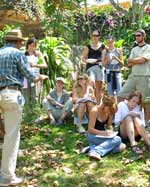
| Learning about sustainable agriculture at a local field site |
|
|
*Elementary Conversational Spanish (3 cr.)
An intensive introductory Spanish course for students with little or no previous experience. Emphasis is on oral practice of themes used in everyday life while living in Costa Rica so as to provide the skills needed to communicate effectively in various aspects of the host culture on a day-to-day basis. No prerequisite. Three undergraduate units.
See a tentative syllabus here (Adobe pdf document).
USJ Credit: BE 105; Español Básico y Laboratorio Pedagógico
*Intermediate Spanish (3 cr.)
An intensive intermediate Spanish course for students who have recently completed at least one-year of college-level Spanish. Emphasis is on review of vocabulary and sentence structure, as well as oral practice in everyday life while living in Costa Rica. Prerequisite: One year of college Spanish, instructor approval required. Three undergraduate units.
See a tentative syllabus here (Adobe pdf document).
USJ Credit: BEE 128; Español y Laboratorio Pedagógico II
Directed Study (1-3 cr.; B y special arrangement only)
A personalized, in-depth, learning opportunity in Sustainable Global Stewardship within the Costa Rican context. Includes individual consultations and community service learning work, or other independent study. Possible themes include agriculture, land use, sustainable business, environmental conservation, sustainable energy, community development, ecotourism, regional studies, social services, or other topics as approved. Instructor approval required. See examples of past projects in the MediaBlog, and a tentative syllabus here (Adobe pdf document).
USJ Credit:
EDG 021;
Métodos y Ténicas de Investigación
NOTE:* Participants will enroll in one level of Spanish, depending on their experience level, unless they are advanced Spanish speakers.
Faculty
Courses will be held at the University of San José (USJ) in San Ramón by regular EEI faculty and visiting professors. Additional faculty information can be found in the Staff section of the 'About Us' page for details on credentials, professional and teaching experience, and other information of interest. Additionally, specialists in the field will provide many guest lectures at different sites.
| |
|
|
| |
|
|
| |

Sample Spring calendar
(click on image to view
pdf)
|
|
Calendar
The unique condensed semester calendar is approximately nine weeks in length, yet affords the participants sixteen units of academic credit along with significant field study and volunteer work. This arrangement
facilitates an in-depth immersion experience, while still providing participants personal time on their own in San Ramón and during extended weekends.
A typical week consists of six days of programmed activities: Two to five days in the classroom, and one to four days in the field.
Although this design requires more attention to studies during the program, it has the benefit of ending early during spring semester, thus allowing participants to stay in-country after the program has ended (or arriving prior to the start of the program) for either additional volunteer opportunities or personal travel on their own (Note: See 'Important Travel Notes' below).
IMPORTANT TRAVEL NOTES:
1.
Visitors to Costa Rica are only granted a 90-day visa upon arrival. Thus, if participants wish to arrive prior to the start of the program on their own, they must do so NO EARLIER THAN MID-JANUARY. Early arrivals or extended stays will also necessitate purchasing additional travel insurance on your own. The included insurance is valid ONLY for the dates of the program.
2. When planning your flight, please note that IT IS NECESSARY TO COORDINATE ARRIVAL AND DEPARTURE DATES/TIMES if you would like to take advantage of provided transport to/from the airport. See the 'Arrival' section on the 'Preparation' page for details.
Homestay
Participants will be living with middle-class families while in San Ramón. The families inevitably do what they can to make you feel comfortable in their home. Specific circumstances vary from family to family; however, one bit of advice that would apply to everyone is: YOU GET OUT OF IT WHAT YOU PUT IN TO IT! Sundays and holidays are thought of as family days and most stores are closed. Families often visit nearby outdoor recreational areas on these days. Homestay recommendations are available on the 'Policies' page.
| |
|
|
| |
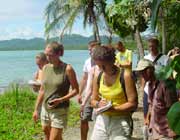
Typical field study: Learning about tropical forest conservation while touring a national park
|
|
|
| |
|
|
Program Fee
Participants pay a comprehensive fee for the program in the amount of approximately $9,730 (see costs). The fee includes the vast majority of in-country expenses associated with the program, including the following:
- All homestay costs in San Ramón (lodging, three meals per day & laundry service)
- All in-country transportation , including airport pickup & drop-off
- Field study travel costs : Lodging, entrance fees, translation, & accompaniment
- Twelve units of academic credit from the University of San José in Costa Rica
- Travel & medical insurance (by reimbursement, with a deductible)
- Personalized pre-departure planning & advising
- Use of our partner university facilities in San Ramón (e.g., computers & internet)
- Some meals during field study travel (1+ meals/day)
- In-country orientation & most cultural activities
- Fourteen days of field study travel in Costa Rica
- Four day field excursion to Nicaragua
- Local personal, logistical & emergency support
- Additional volunteer opportunities
Participants are responsible for purchasing international airfare, course materials, any additional health insurance they may desire, personal expenses for such things as souvenirs, required personal items, some food during program travel, and any personal travel not associated with the program. Please note that there may also be a few minor additional costs (e.g. local bus fare) associated with field study or volunteer work, and additional tuition fees apply for the optional Directed Study course if requested. For most participants, personal costs average approximately $100 per week. Scholarship money is available from other organizations that specialize in funding study abroad (see costs), and most financial aid can be applied to offset program fees .
Application
Application for this program is to be made directly to EEI. See the 'Admission' page for details.
Please note the application deadline of 30 October, 2027.
NOTE: Javascript must be enabled to enlarge pictures by clicking on them.
Comments about this site may be submitted via the 'Contact Us' page.
© Copyright, Earth Education International
|
|
|